working paper

Congestion Pricing and the Future of Transit

Publication Date

October 30, 1995

Associated Project

Abstract

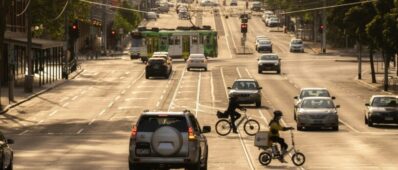
Congestion pricing provides opportunities for transit to become more self-reliant. Both the theory of congestion pricing and its use in congested US corridors are examined. A 5% increase in commuter demand for transit is estimated in suburban corridors. New opportunities for transit are required if transit is to remain competitive in the USA. Automobile commuting is faster and more convenient as well as generously cross-subsidized for most US urban commuters.

Suggested Citation
Gordon J. Fielding (1995) Congestion Pricing and the Future of Transit. Working Paper Reprint No. 330. Institute of Transportation Studies, UC Irvine: University of California Transportation Center. Available at: https://escholarship.org/uc/item/0g332530.

published journal article

Framework for deriving macroscopic demand functions from microscopic acceleration models

Transportation Research Record

Publication Date

January 1, 2017
Suggested Citation
Anupam Srivastava and Wen-Long Jin (2017) “Framework for deriving macroscopic demand functions from microscopic acceleration models”, Transportation Research Record, 2623(1), pp. 40–48. Available at: 10.3141/2623-05.

Phd Dissertation

Anonymous vehicle tracking for real-time traffic performance measures

Suggested Citation
Cheol Oh (2003) Anonymous vehicle tracking for real-time traffic performance measures. PhD Dissertation. UC Irvine. Available at: https://uci.primo.exlibrisgroup.com/permalink/01CDL_IRV_INST/17uq3m8/alma991014364619704701.

published journal article

Agent-Based Mobility Simulation for Potential Cost and Benefits of Subscription Services with Associated Cost Structures

Transportation Research Record

Abstract

This study aims to present a method to analyze the problems that arise from the increasing use of shared mobility systems to solve the current problems of congestion. The use of shared and/or autonomous vehicles (SAVs) is beneficial since it could reduce the number of vehicles on the roads. On the other hand, the increased usage of SAVs to fulfill the same transportation needs would affect the total life of those vehicles. Current cost models are based on average values and life cycles of 15 years; they may not be useful in the case of increased daily travel miles of vehicles when subscription-based shared mobility systems become prevalent. In this paper, we present a comprehensive framework which considers the interactions of new cost structures and the system performance under new mobility schemes. This paper envisions the scenarios that will exemplify the importance of considering the changing costs because of the increased mileage of vehicles. Cost functions are properly designed to assess the new scenarios, a pricing scheme is introduced from the service provider’s point of view to adjust the demand for the services and the profits, an agent-based simulation platform is presented, and a framework is demonstrated to consider the interactions and optimize the system.

Suggested Citation
Eduardo Marino and R. Jayakrishnan (2024) “Agent-Based Mobility Simulation for Potential Cost and Benefits of Subscription Services with Associated Cost Structures”, Transportation Research Record, 2678(3), pp. 207–218. Available at: 10.1177/03611981231179471.

working paper

Probing a Traffic Congestion Controversy: Density and Flow Scrutinized

Publication Date

August 17, 1999

Author(s)

Hiroshi Ohta

Working Paper

UCI-ITS-WP-99-4

Abstract

Probing a die-hard traffic congestion controversy, this paper scrutinizes two key variables, density and flow, under equilibrium versus optimal states. We find that optimization requires flow in equilibrium to decrease under mild congestion, but flow must increase under hyper-congestion. However, while under hyper-congestion flow should be increased by decreasing density, a mild congestion requires flow to be decreased by decreasing density. Thus, in flow of vehicles should always be discouraged to either increase or decrease flow of vehicles for economic efficiency. Moreover, even when optimal policy, given traffic demand, requires flow to increase, the optimal flow itself must decrease eventually as demand increases beyond a critical level. 

Suggested Citation
Hiroshi Ohta (1999) Probing a Traffic Congestion Controversy: Density and Flow Scrutinized. Working Paper UCI-ITS-WP-99-4. Institute of Transportation Studies, Irvine. Available at: https://escholarship.org/uc/item/4vr3m3fm.

published journal article

Hardware/Software Co-Design for Sensor Security

Computer

Publication Date

May 1, 2023

Author(s)

Anomadarshi Barua, Mohammad Al Faruque

Abstract

Most sensors cannot differentiate between legitimate signals and spoofing signals. Therefore, a novel research focus is required using hardware/software co-design techniques in the sensor computation domain to detect, contain, and eradicate spoofing signals in sensors.

Suggested Citation
Anomadarshi Barua and Mohammad Abdullah Al Faruque (2023) “Hardware/Software Co-Design for Sensor Security”, Computer, 56(5), pp. 122–125. Available at: 10.1109/MC.2023.3248779.

published journal article

A numerical solution of axisymmetric problems in elastodynamics

International Journal for Numerical Methods in Engineering

Publication Date

July 1, 1971

Author(s)

Abstract

Abstract The equations governing the axisymmetric dynamic deformation of an elastic solid are considered as a symmetric hyperbolic system of linear first‐order partial differential equations. The characteristic properties of the system are determined and a numerical method for obtaining the solution of mixed initial and boundary value problems in elastodynamics is presented. Two examples are considered.

Suggested Citation
W. W. Recker (1971) “A numerical solution of axisymmetric problems in elastodynamics”, International Journal for Numerical Methods in Engineering, 3(3), pp. 361–377. Available at: 10.1002/nme.1620030306.

published journal article

Dynamic autonomous vehicle fleet operations: Optimization-based strategies to assign AVs to immediate traveler demand requests

Transportation Research Part C: Emerging Technologies

Publication Date

July 1, 2018

Author(s)

Michael Hyland, Hani Mahmassani

Abstract

Motivated by the growth of ridesourcing services and the expected advent of fully-autonomous vehicles (AVs), this paper defines, models, and compares assignment strategies for a shared-use AV mobility service (SAMS). Specifically, the paper presents the on-demand SAMS with no shared rides, defined as a fleet of AVs, controlled by a central operator, that provides direct origin-to-destination service to travelers who request rides via a mobile application and expect to be picked up within a few minutes. The underlying operational problem associated with the on-demand SAMS with no shared rides is a sequential (i.e. dynamic or time-dependent) stochastic control problem. The AV fleet operator must assign AVs to open traveler requests in real-time as traveler requests enter the system dynamically and stochastically. As there is likely no optimal policy for this sequential stochastic control problem, this paper presents and compares six AV-traveler assignment strategies (i.e. control policies). An agent-based simulation tool is employed to model the dynamic system of AVs, travelers, and the intelligent SAMS fleet operator, as well as, to compare assignment strategies across various scenarios. The results show that optimization-based AV-traveler assignment strategies, strategies that allow en-route pickup AVs to be diverted to new traveler requests, and strategies that incorporate en-route drop-off AVs in the assignment problem, reduce fleet miles and decrease traveler wait times. The more-sophisticated AV-traveler assignment strategies significantly improve operational efficiency when fleet utilization is high (e.g. during the morning or evening peak); conversely, when fleet utilization is low, simply assigning traveler requests sequentially to the nearest idle AV is comparable to more-advanced strategies. Simulation results also indicate that the spatial distribution of traveler requests significantly impacts the empty fleet miles generated by the on-demand SAMS.

Suggested Citation
Michael Hyland and Hani S. Mahmassani (2018) “Dynamic autonomous vehicle fleet operations: Optimization-based strategies to assign AVs to immediate traveler demand requests”, Transportation Research Part C: Emerging Technologies, 92, pp. 278–297. Available at: 10.1016/j.trc.2018.05.003.

policy brief

Connected Vehicle Technology and AI Could Help Reduce Highway Congestion through Better Utilization of Park and Ride Facilitie

Abstract

Considerable advancements have been made in traffic management strategies to address highway congestion over the past decades; however, the continuous growth of metropolitan regions has impeded such progress. In response, transportation planners have given special attention to integrated corridor management (ICM), an approach that coordinates various traffic control units (e.g., ramp metering) to optimize their operations along the entire freeway. Emerging connected vehicle (CV) technology is expected to substantially benefit ICM, where vehicles can communicate with each other and surrounding roadway infrastructure. The combined potential of ICM strategies and CVs could be even greater if combined with strategies that leverage underutilized infrastructure (specifically park-and-ride facilities) to reduce the total number of vehicles on the roadway.

Suggested Citation
Mohamad Habib Fakih, Mohammad Abdullah Al Faruque, Mohanad Odema and Tyler Zhang (2023) Connected Vehicle Technology and AI Could Help Reduce Highway Congestion through Better Utilization of Park and Ride Facilitie. Policy Brief. UC ITS. Available at: https://doi.org/10.7922/g22n50mf.