Project Summary
This project represents collective projects funded under the University of California Transportation Center (UCTC) that was authorized by Congress by the Transportation Equity Act for the 21st Century in fall 1998.
Fellowships provided under UCTC (TEA-21)
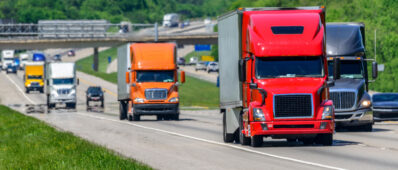
The San Pedro Bay Ports (SPBP) of Los Angeles and Long Beach in Southern California comprise one of the largest and busiest container port complexes in the world, and contribute significantly to both our regional and national economies. However, the SPBP complex is a major contributor to air pollution. Local communities adjacent to the ports and associated intermodal facilities are believed to bear a disproportionate burden of the health impacts (respiratory and cardiovascular illness, cancer and premature death) associated with this pollution. A particular concern is emissions from heavy duty diesel trucks (HDDTs), or drayage trucks, which form an unusually large proportion of vehicles on nearby freeways and arterials and which carry port cargo (mostly containers) to and from the ports and intermodal rail and transloading facilities. Our existing UCTC research has developed a new modeling approach to evaluate the health and environmental justice impacts of various SPBP freight corridor operations and pollution mitigation strategies. However, our modeling of HDDTs only addresses the freeway network. This research will therefore complete a major missing link by modeling HDDT drayage truck operations on arterial roads, thereby providing new and more accurate insights into the emission impacts of alternative multimodal SPBP freight corridor operations.
The transportation sector accounts for nearly one third of the US greenhouse gas (GHG) emissions (Green and Shafer, 2003), and until recently, its emissions have kept on increasing. Transportation is also producing a large percentage of local pollutants such as PM, NO2, or CO. Much discussed solutions to address this problem include raising efficiency standards, blending low-carbon fuels with gasoline, or changing land-use patterns through urban design and planning. Another possibility, which has not attracted much attention so far, is to rely on new technologies such as adaptive cruise control (ACC) and inter-vehicle communications (IVC) to improve traffic flow and vehicle fuel economy while reducing the emissions of various pollutants. The purpose of this project is to address this knowledge gap. Using micro-simulation, we will investigate the impact on highway capacity and vehicle emissions when a subset of vehicles are equipped with ACC and IVC technologies, with an application to a section of the I-80. We will then develop driving strategies to maximize energy efficiency of vehicles equipped with IVC and ACC. Quantifying the environmental benefits of these new technologies is important to understand if new technologies like ACC and IVC could contribute significantly to greening transportation.
One such project that interests me is studying LA Metroâs GoPass Fareless pilot program. As a bold initiative in the midst of the COVID-19 pandemic, being a part of a future where ridership is more equitable through researching such a program is something I would want to do, especially with similar programs like the OC Youth Ride Free similarly enacted. [A topic from JDS] Researching transit agencies and their partnerships with rideshare companies is an exciting opportunity to understand the reasons for embracing new forms of public transit that utilizes pre-existing infrastructure. [A topic from Jay] Other projects like those by the STaNCE lab also interest me for their technical focus. [STANCE is Roy's lab]
[Kaitlyn was recruited by JDS]